

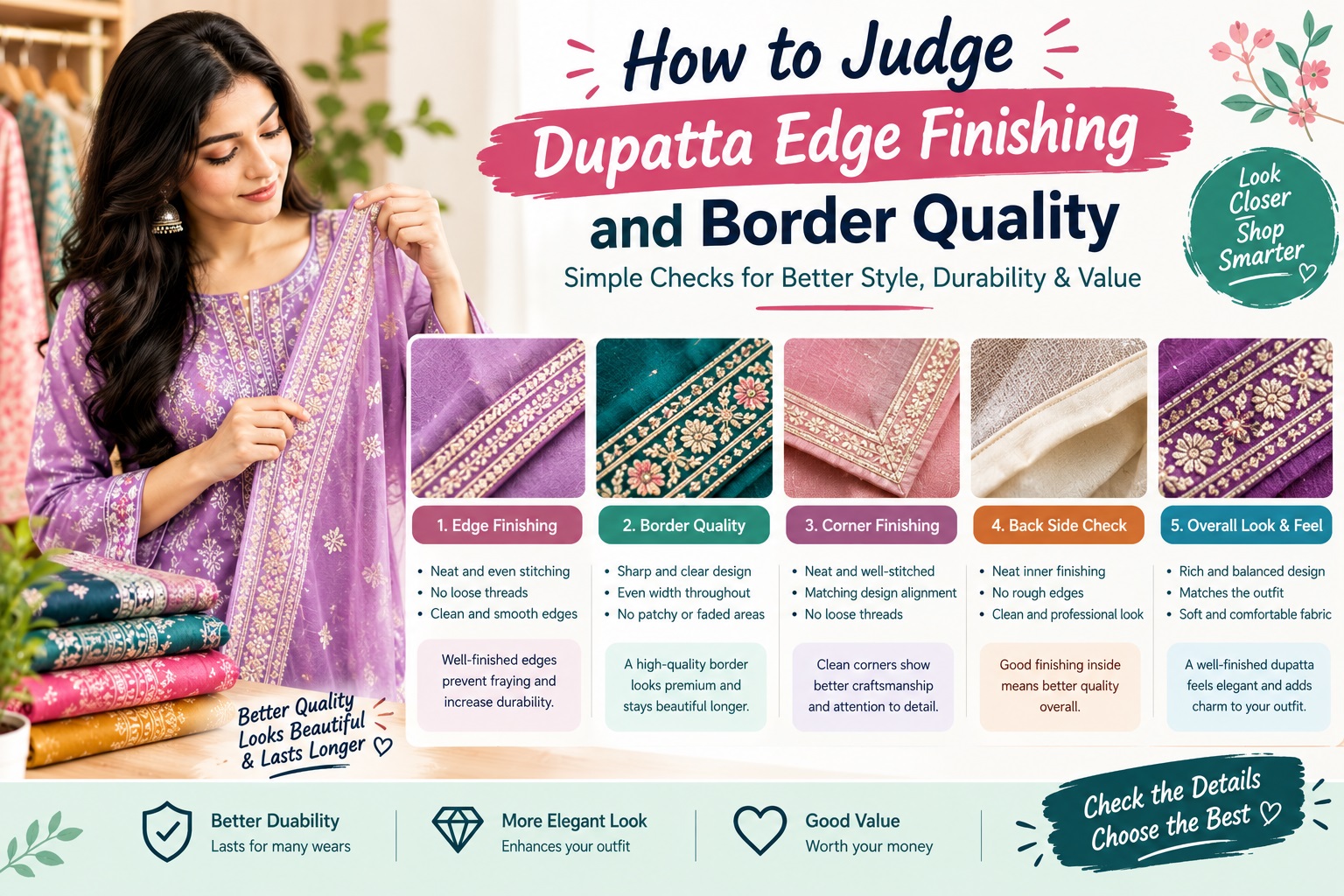
How to Judge Dupatta Edge Finishing and Border Quality focuses on one practical part of buying and maintaining three piece dresses online. Dupatta edges receive constant handling and are often visible from both sides, so rolled hems, borders and corner finishing deserve their own quality check.
What this quality check tells you
Determine whether the dupatta will drape cleanly and resist fraying after repeated use. If information is missing, ask a specific question before ordering. A clear answer is more useful than assuming the product will match the best possible interpretation of the listing.
Read the product description
Identify the dupatta material first because chiffon, organza, voile and woven cotton need different edge treatments. Keep the exchange window in mind until the garment has been inspected in natural light and tested for basic fit. Do not alter or wash a questionable item before deciding whether it should be kept.
Photo evidence
Request full-length photos and close-ups of corners; a centre-detail image cannot show whether borders are straight. Think about total value rather than the listed price alone. Tailoring, special cleaning and new supporting pieces can change the true cost of an apparently inexpensive outfit.
Measurements
Check stated length and width because border weight feels different on a narrow versus very large dupatta. Check what can be verified before payment and what can only be confirmed after delivery. Clear measurements, close-up photos and construction details reduce uncertainty, while vague quality claims do not.
Fabric connection
Fine sheer fabric needs light edge finishing, while woven cotton can support a wider stitched or woven border. Use a garment you already trust as a reference. Familiar construction and measurements make it easier to judge whether the new product is likely to fit your routine rather than just look attractive online.
Construction detail
Rolled hems should be even, machine hems should not wave excessively and attached borders should sit flat. Consider durability together with comfort. A well-made detail should survive repeated movement, washing and storage without creating extra work every time the outfit is worn.
Kameez inspection
Compare border formality with the kameez; a very heavy edge can make a simple everyday top feel unbalanced. If information is missing, ask a specific question before ordering. A clear answer is more useful than assuming the product will match the best possible interpretation of the listing.
Trouser inspection
Trouser colour can repeat a dupatta border tone and help connect the set without adding another print. Keep the exchange window in mind until the garment has been inspected in natural light and tested for basic fit. Do not alter or wash a questionable item before deciding whether it should be kept.
Dupatta inspection
Inspect all four edges and corners, not just the decorated end shown over the shoulder in model photography. Think about total value rather than the listed price alone. Tailoring, special cleaning and new supporting pieces can change the true cost of an apparently inexpensive outfit.
Colour and finish
Check whether border dye or metallic thread could transfer or bleed onto pale sheer fabric. Check what can be verified before payment and what can only be confirmed after delivery. Clear measurements, close-up photos and construction details reduce uncertainty, while vague quality claims do not.
Natural-light check
Backlighting shows frayed threads, uneven transparent hems and glue marks more clearly. Use a garment you already trust as a reference. Familiar construction and measurements make it easier to judge whether the new product is likely to fit your routine rather than just look attractive online.
Close-up check
Zoom into corners where rolled hems or attached borders often become bulky or untidy. Consider durability together with comfort. A well-made detail should survive repeated movement, washing and storage without creating extra work every time the outfit is worn.
Video check
Movement reveals whether the border is so heavy that it pulls the dupatta downward or prevents a natural drape. If information is missing, ask a specific question before ordering. A clear answer is more useful than assuming the product will match the best possible interpretation of the listing.
Seller questions
Ask whether stones, lace or borders are stitched or glued and whether both short ends are finished the same way. Keep the exchange window in mind until the garment has been inspected in natural light and tested for basic fit. Do not alter or wash a questionable item before deciding whether it should be kept.
Review clues
Look for comments about fraying, border detachment, scratchy edges and difficulty draping. Think about total value rather than the listed price alone. Tailoring, special cleaning and new supporting pieces can change the true cost of an apparently inexpensive outfit.
Exchange considerations
If an expensive dupatta arrives with unfinished edges or detached trim, document it before attempting repair. Check what can be verified before payment and what can only be confirmed after delivery. Clear measurements, close-up photos and construction details reduce uncertainty, while vague quality claims do not.
Total cost
A simpler well-finished dupatta may offer better value than a heavily bordered one that needs frequent repairs. Use a garment you already trust as a reference. Familiar construction and measurements make it easier to judge whether the new product is likely to fit your routine rather than just look attractive online.
Delivery inspection
Lay the dupatta flat and compare edge straightness, corner shape and whether the fabric is cut square. Consider durability together with comfort. A well-made detail should survive repeated movement, washing and storage without creating extra work every time the outfit is worn.
Movement test
Drape it several ways to see whether the edge weight supports or fights the styling you prefer. If information is missing, ask a specific question before ordering. A clear answer is more useful than assuming the product will match the best possible interpretation of the listing.
First-wash lesson
Follow the care method of the most delicate edge component; trim and lace may need gentler treatment than the base cloth. Keep the exchange window in mind until the garment has been inspected in natural light and tested for basic fit. Do not alter or wash a questionable item before deciding whether it should be kept.
Long-term care
Store bordered dupattas so rough embellishment does not snag the centre fabric or neighboring garments. Think about total value rather than the listed price alone. Tailoring, special cleaning and new supporting pieces can change the true cost of an apparently inexpensive outfit.
Repeat-wear value
A versatile well-finished dupatta can refresh several plain kameez designs and often provides excellent cost per wear. Check what can be verified before payment and what can only be confirmed after delivery. Clear measurements, close-up photos and construction details reduce uncertainty, while vague quality claims do not.
Common mistakes
Do not judge only the centre print or embroidery while ignoring edges that will be handled every time the dupatta is worn. Use a garment you already trust as a reference. Familiar construction and measurements make it easier to judge whether the new product is likely to fit your routine rather than just look attractive online.
Final checklist
Check material, size, all edges, corners, border attachment, weight, colourfastness and care. Consider durability together with comfort. A well-made detail should survive repeated movement, washing and storage without creating extra work every time the outfit is worn.
Frequently asked questions
What should I check first?
Inspect corners and the heaviest border area first.
When should I request more evidence?
Ask when the border material or attachment method is unclear.
What should make me stop and reconsider?
Pause when edges are fraying, borders wave badly or glued decoration is already lifting.
Final thoughts
Dupatta quality is visible at the edges. Clean finishing and manageable border weight make the piece easier to wear and longer lasting.
Explore related buying guides at Navya Style. External ecommerce reference: Trativaa.